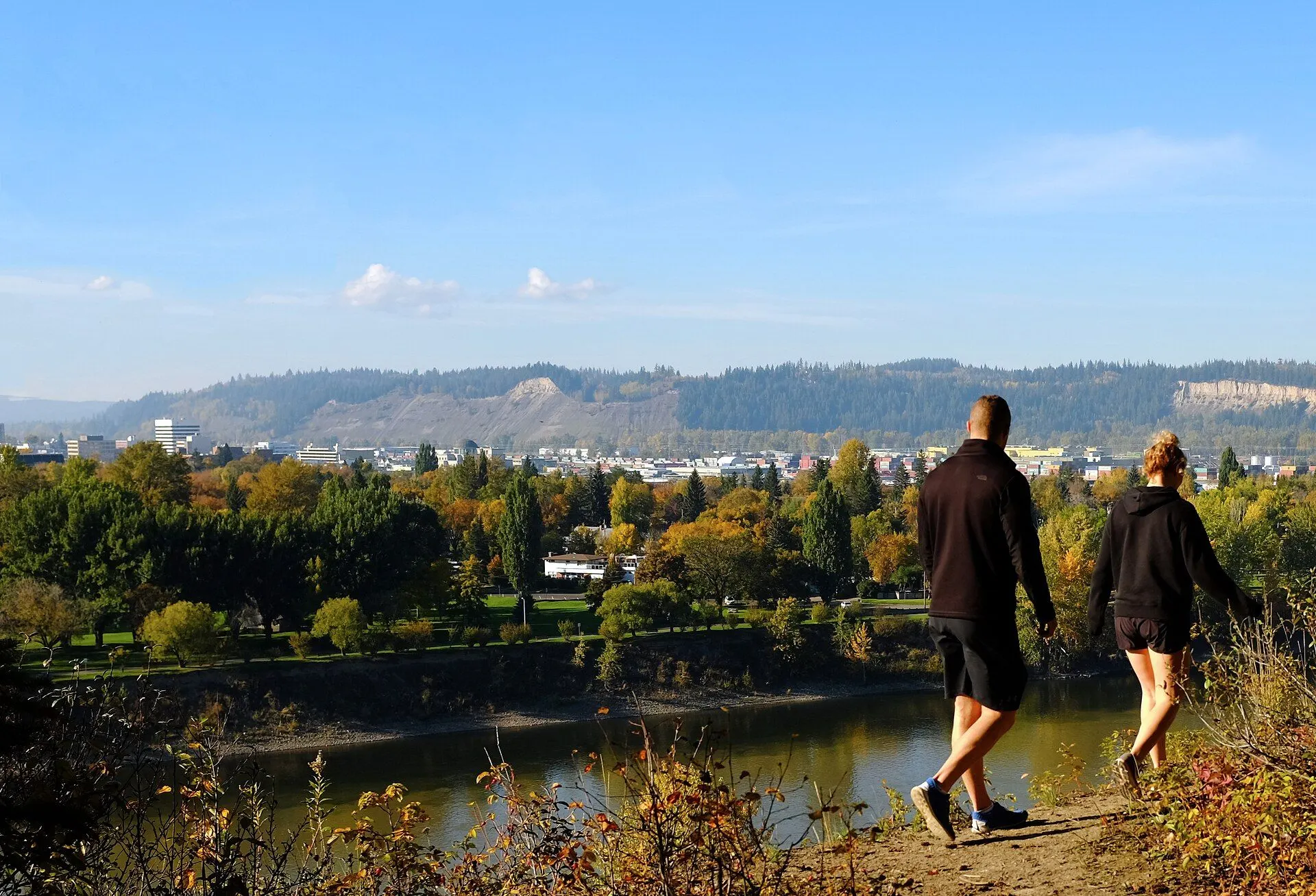
Where two rivers meet
Prince George is built around the confluence of the Fraser and Nechako rivers. It is the homeland of the Lheidli T'enneh First Nation, whose name means the people of the confluence of the two rivers. The riverside park formerly known as Fort George Park now carries the name Lheidli T'enneh Memorial Park.
The city is often called BC's northern capital because so many services for the north are based here: health care, higher education, government offices, arts, sport and industry.
Getting around
Highways 16 and 97 cross in Prince George, linking the city east to Jasper, west to the coast and north and south through the province. The Canadian National Railway runs through the city, and VIA Rail's Jasper to Prince Rupert train stops here overnight. Prince George Airport, just inside the city's southern boundary, has scheduled flights to Vancouver and other cities.
Most people drive, especially outside the central neighbourhoods, though downtown and the Bowl have many bus routes.
Education
The University of Northern British Columbia opened in 1990 on a hilltop campus on Cranbrook Hill overlooking the city. The College of New Caledonia, established in Prince George in 1969, has its main campus on 22nd Avenue. School District 57 runs the city's public schools, including French Immersion programs, and serves a large area to the north and east.
Health care
The University Hospital of Northern British Columbia is the largest acute care hospital in Northern Health and the referral centre for communities across the north. It supports the Northern Medical Program, run jointly by UBC and UNBC. Northern Health, the regional health authority, is centred in Prince George, and BC Cancer's Centre for the North is here too.
Neighbourhoods at a glance
Most of the older city sits in the Bowl, the valley that holds downtown and the central neighbourhoods. College Heights and University Heights are on the southwest side near UNBC. The Hart is north of the Nechako River. Beyond city limits, rural areas offer acreages, farms and lake properties.
Outdoor life
Trails start inside the city. Forests for the World, Cottonwood Island Nature Park, Connaught Hill Park and the Heritage River Trail are all within city limits. In winter, the Otway Nordic Centre north of the city grooms more than 40 km of cross-country trails and has a biathlon range, the Hart Highlands Ski Hill is a family hill in the middle of a neighbourhood, and Tabor Mountain is east of town. Lakes like Ness, Tabor and Cluculz are a short drive away.
Arts, culture and sport
Two Rivers Gallery is downtown on Canada Games Way. Exploration Place, the museum and science centre in Lheidli T'enneh Memorial Park, has a paleontology gallery, a First Nations exhibit, a children's gallery, a sports hall of fame and a narrow-gauge railway. CN Centre hosts hockey, concerts and events. Prince George hosted the Canada Winter Games in 2015, part of its 100th anniversary celebrations.
Winter, honestly
Prince George has a humid continental climate, close to subarctic. Winters are milder than the latitude suggests, but cold Arctic air can settle over the city for weeks at a time, and snowfall at the airport averages about 2 m a year. Summers are warm with cool nights.
When you buy, ask about the heating system and its costs, the age of the windows and insulation, the garage, and how the driveway faces. They matter more here than in many places.
Work and the economy
Service industries, including health care and education, lead the local economy. Forestry shaped the city through the 20th century, with sawmills and pulp mills, and Prince George remains a hub for transportation, government, mining supply and other industry across the north.